
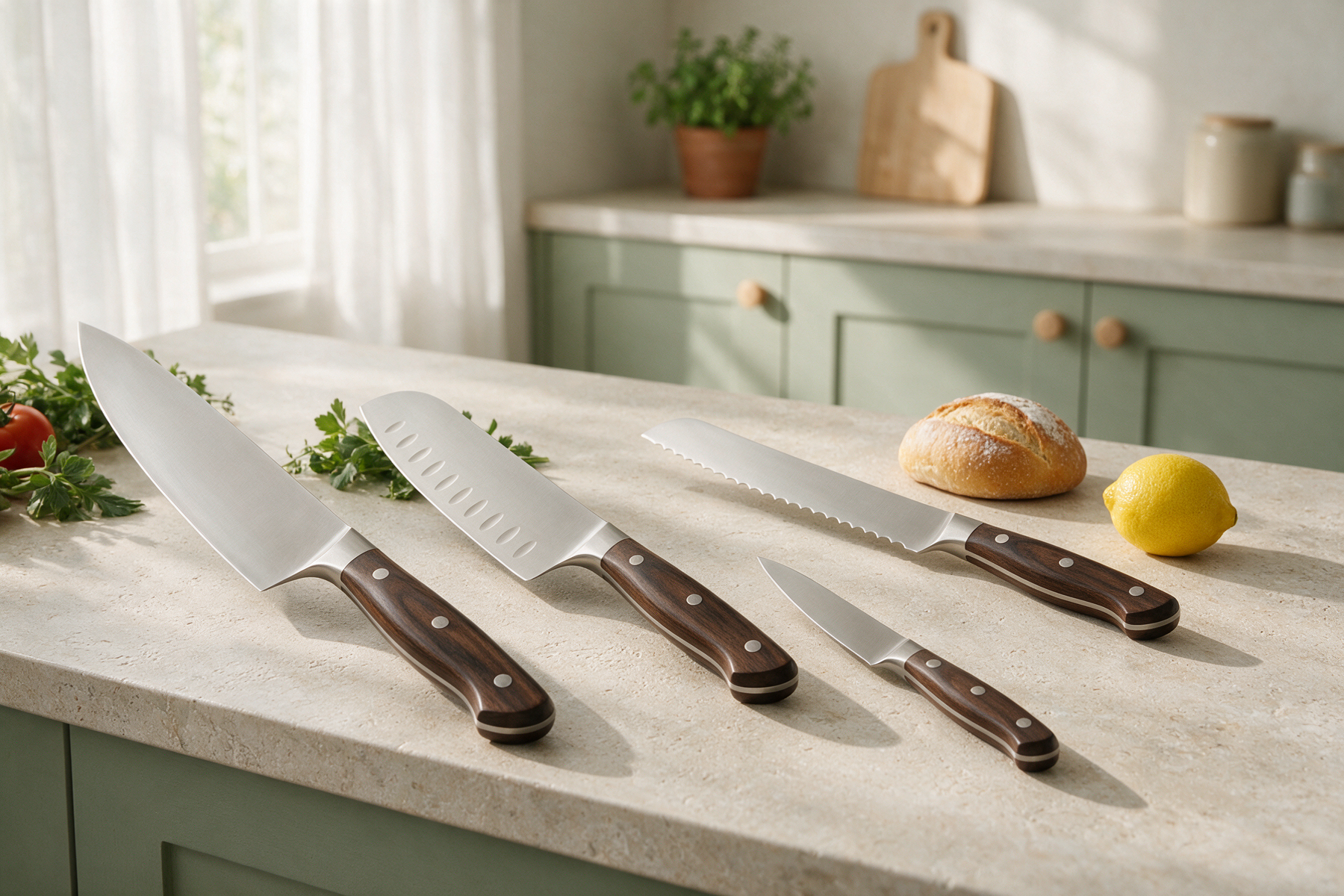
The right kitchen knife is not the most expensive or the largest one. It is the knife whose shape matches the food, the motion and the amount of control the task requires. A small, useful set can cover nearly every everyday meal when each blade has a clear role.
This guide focuses on four practical profiles: the chef knife, santoku, bread knife and paring knife. None is better at everything. The easiest way to choose is to start with what you are cutting and how you naturally move the blade.
The quick decision guide
- Choose a chef knife for versatile chopping, slicing and rocking cuts across vegetables, herbs and boneless proteins.
- Choose a santoku for controlled push cuts, compact prep spaces and repeated vegetable work.
- Choose a bread knife for crusty bread, soft loaves and delicate foods that would compress under a straight edge.
- Choose a paring knife for peeling, trimming and small detail work where a full-size blade feels clumsy.
Chef knife: the versatile starting point
An 8-inch chef knife is the broadest everyday option. Its curved belly supports a gentle rocking motion, while the long edge makes it useful for slicing larger vegetables and boneless proteins. The blade height also creates space for the knuckles when chopping on a board.
Reach for it when you are:
- chopping onions, carrots, celery or leafy greens;
- mincing herbs with a controlled rocking motion;
- slicing boneless meat or larger fruit;
- working through a mixed recipe with several ingredients.
A chef knife is not designed for bones, frozen food, prying or twisting. Those uses can damage the edge and reduce control. If you want one main blade before adding specialised profiles, the Food Wellness Labs 8-Inch Chef Knife is the most flexible place to begin.
Santoku: precise push cuts and compact control
A santoku usually has a straighter edge and a lower tip than a chef knife. That profile feels natural with a forward-and-down push cut rather than a large rocking motion. The shorter 7-inch length can also feel more manageable on a compact board.
Reach for it when you are:
- slicing and dicing vegetables in repeated, even cuts;
- portioning boneless proteins;
- making thin slices where a flatter cutting path helps;
- working in a smaller preparation area.
Hollow-edge indentations can reduce the contact area between the blade and some moist ingredients, although no knife is completely stick-free. Choose the 7-Inch Santoku Knife when you prefer a compact feel and a push-cut motion.
Bread knife: let the serrations do the work
A serrated bread knife solves a specific problem: cutting through a firm exterior without crushing a soft interior. Instead of pressing down, use a light sawing motion and allow the serrations to enter the crust gradually.
Reach for it when you are:
- slicing sourdough, baguettes and soft sandwich loaves;
- cutting ripe tomatoes without compressing them;
- portioning delicate cakes or pastries;
- working with food that has a tough skin and soft centre.
A serrated knife is not a substitute for a general chopping blade. Keep it for draw-and-saw cuts and avoid twisting it in the food. See the 8-Inch Bread Knife.
Paring knife: control for small work
A paring knife gives you a short edge and a fine point for detail. It is useful when a chef knife blocks your view or feels oversized for the ingredient.
Reach for it when you are:
- peeling or trimming small fruit and vegetables;
- removing strawberry tops or blemishes;
- segmenting citrus or making shallow detail cuts;
- preparing garnishes with controlled movements.
Use a stable cutting board whenever possible, keep the blade moving away from your supporting hand and never attempt heavy chopping with a small knife. The 9 cm Paring Knife is designed for these smaller tasks.
Do you need all four?
Not immediately. A chef knife, paring knife and bread knife form a practical three-profile foundation: one versatile blade, one detail blade and one serrated blade. Add a santoku when you know you prefer its straighter cutting path or want a second general-purpose profile.
The 3-Piece Everyday Prep Knife Set combines a chef knife, santoku and paring knife for cooks whose routine centres on vegetables, boneless proteins and detailed preparation. Add the bread knife separately if loaves, tomatoes or pastries are regular parts of the week.
Five questions to ask before choosing
- What am I cutting? Size, texture and surface toughness narrow the choice quickly.
- What motion suits the task? Rocking favours the chef profile; push cutting favours the santoku; sawing requires serrations.
- How much detail do I need? Smaller work benefits from a shorter blade and clearer sight line.
- Is the board stable? Place a damp towel under a board that moves, and keep the work surface clear.
- Is the edge appropriate and maintained? A suitable sharp knife requires less force and is easier to guide than a neglected edge.
The simplest rule
Match the blade to the food instead of forcing one knife through every task. Use the chef knife for versatility, the santoku for compact push cuts, the bread knife for firm skins and soft interiors, and the paring knife for detail. Clear roles make preparation calmer, safer and more repeatable.